In 2024, I spent considerable time talking to tour operators in Cape Town, South Africa. As someone interested in technology and intra-African travel, I wanted to understand how tourism impacts their businesses. I was also on a quest to discover a real-world problem that I could solve through technology.
Travel, tourism, and hospitality is a massive, complex industry with many moving parts. I was particularly interested in learning about tours and experiences, specifically, how the unique beauty of Africa is presented to the rest of the world. By talking to these operators, I got to hear about their challenges and lived experiences firsthand.
South Africa is no doubt the heartbeat of the continent’s tourism economy. It felt like the right place to begin my research because, naturally, if you want to understand the scale of African travel, you have to look at its most mature market. What I discovered was a striking paradox: while the "product" – the safari, the coast, the culture – is world-class, the backend systems are often held together by spreadsheets and hope. The industry is changing faster than the tech, and the recent data from South Africa serves as a perfect case study to understand where the industry is heading.
In 2025, South Africa moved an entire subcontinent’s worth of people. The country welcomed a staggering 10.48 million international arrivals. To put that in perspective, that is nearly equal to the combined populations of Namibia, Botswana, Lesotho, Gabon, and the Seychelles.
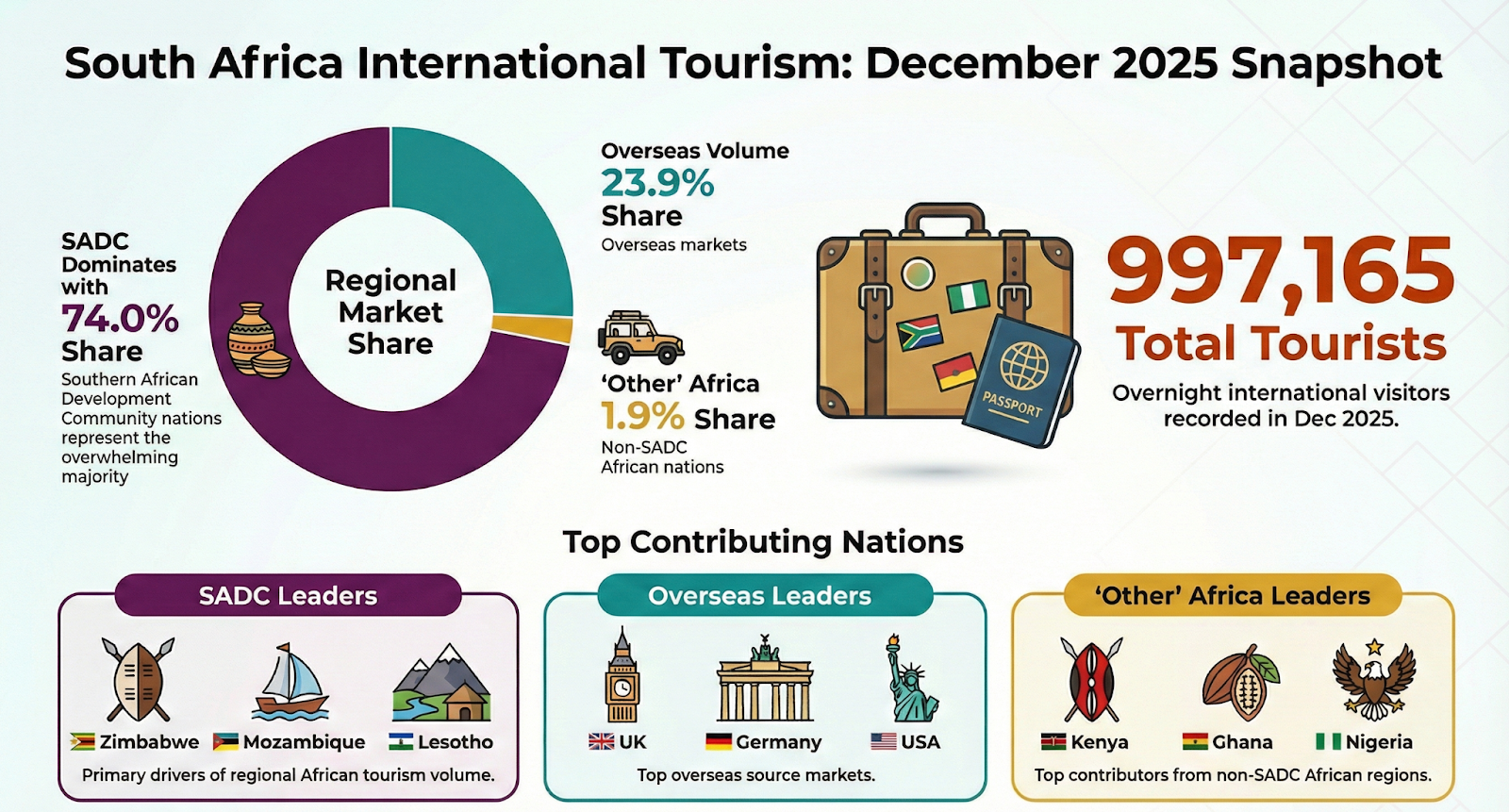
The impact of tourism in South Africa extends far beyond just capturing beautiful travel photos. Currently, the tourism sector supports 1.8 million jobs. The math is simple: for every 13 international arrivals, one new job is created. Additionally, the government’s new Electronic Travel Authorisation (ETA) system is expected to generate another 100,000 jobs. This shows that the future of African travel is being shaped by digital efficiency and expansion. However, with this tourism growth comes a notable challenge: how can operators efficiently serve these increasing numbers of tourists?
As an entrepreneur, I am keenly aware of the fact that every challenge brings with it a unique set of opportunities. These numbers highlight a few noteworthy opportunities:
Despite the boom in South African tourism, many world-class local operators are still managing millions of guests using inefficient, manual systems. The growth potential is infinite, but the "bottleneck" is operational. High-volume growth requires high-volume efficiency. Tour operators should be focusing on creating amazing experiences, not juggling outdated, disconnected systems just to run their day-to-day business.
Having observed these market gaps, we at Zuru are building an infrastructure designed to empower the people on the ground delivering the African experience. We focus on three things:
We are building Zuru because we believe that African excellence deserves African-led innovation. While we are starting in South Africa, we plan to expand across the continent within the next five years. We want to ensure that when the next 10 million tourists arrive, our tour operators aren’t just surviving the rush, but are scaling with it.
In conclusion, the growth of African tourism is unfolding rapidly. For this growth to be sustainable, we need to build world-class tools to service the sector. Tools that do not just showcase the beauty of Africa, but also improve the efficiency of those tasked with showcasing this beauty. Our quest to solve a real-world problem led us to the resilient operators who power this industry every day, and Zuru is our tribute to their excellence. We aren’t just building software; we’re building the digital backbone for the next era of African travel, ensuring that as the world arrives, our local businesses are ready to lead.